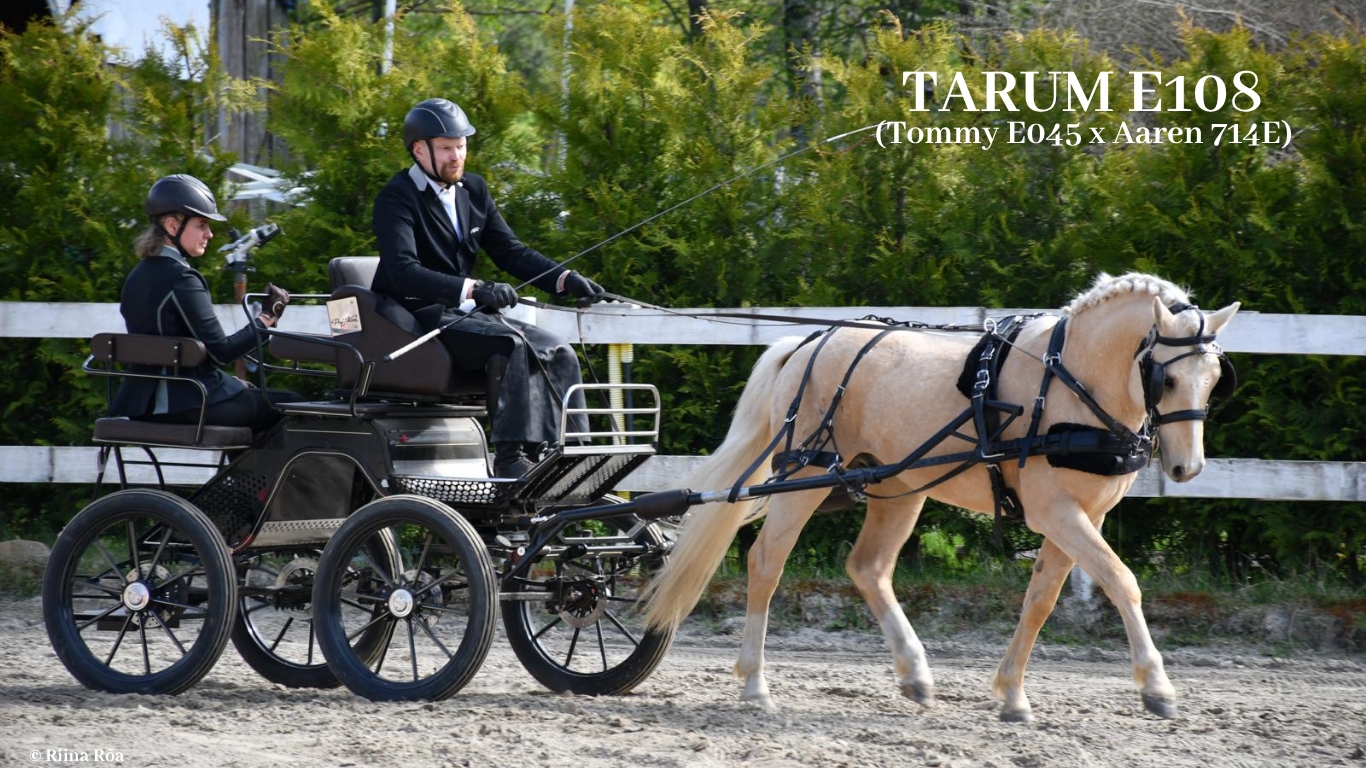
HISTORY
Estonian Native horses have grown out of the Northern Forest Horses and have retained many attributes of their wild ancestors. Aside from prehistoric markings like dorsal and shoulder stripes, the Estonian Native has also inherited remarkable vitality and resilience to survive and thrive in the harsh northern climate. The oldest written mention of the Estonian Native horse comes from the 11th century and there are records of many horses being exported in the 12 th -13 th century by merchants of Novgorod. In the 13th century, the breed was used as a warhorse in the battles across Estonia and Livonia. Czar Peter the First had a very high opinion of the breed and as such, even more horses were exported to Russia.
In peace times, the horses were mainly used for agricultural work, praised for their strength, endurance and easy-going, undemanding nature. As many horses were lost in the wars, purposeful breeding of the Estonian Native was called for at the end of the First World War. The studbook was found in the city of Haapsalu in 1921. Since the aboriginal Estonian Native was relatively small, there was a desireto increase the strength, weight and height of the breed. For this purpose 13 Finnhorse stallions were exported from 1921-1938. From these stallions, the most prominent bloodline founders were Vuhti 136E, Taru 149E and Lari 23E. From the local aboriginal stallions, the bloodlines of Ahti 228E, Raspel 70E, Taube 60E and Eni 8E are still in use.
CHARACTERISTICS
Similar to wild horses, the Estonian Native has survived the natural selection by staying small, alert, agile and robust. The horses are praised for their health and longevity. The pureblood Estonian Native is a pony-sized pacer-type horse.
● The average measurement (in cm):
○ Stallions – height at withers 142, oblique body length 147, chest girth 178, cannon bone girth 19.5
○ Mares: 141, 149, 182 and 19 respectively
● Well-proportioned head with a wide forehead, a lively eye and a wide, muscular jaw.
● Relatively short muscular neck with a thick mane.
● The medium-lenght withers are low-set.
● The back is mostly short, wide and straight. Loin is short, wide and strong.
● The croup is plump and well-rounded, with an average length and width. The tail is low-set and thick.
● The chest is wide and deep, followed by curved ribs and a capacious stomach.
● The legs are short, properly set and distinguished by firmness and cleanness with strong tendons and joints. The hoofs are regular with hard ash-coloured coronet.
● Rare defects to look out for – irregular stand, soft or concave back.
The Estonian Native comes in a large variety of colours: sorrel, chestnut, black, grey, bay, dun, buckskin and cremello/perlino. Common aboriginal tokens are the dorsal stripe and transversed shoulder stripe. The gait is typically wide and active, but there have been cases of dishing and paddling.
COLOURS OF THE ESTONIAN NATIVE
Translated by Helen Kaarlep
The earliest historical notes on the horses in Estonian territories describe the horses to be of a dark colouration – black, bay, brown and mouse dun. Other colours have been added over the centuries in the chaos of wars and with meticulous cross-breeding attempts to modify the horses in Estonia to meet industrial demands. With the mix of aboriginal and domestic genes, the Estonian Native horse has become one of the most amply coloured horse breeds in the world.
Aboriginal Estonian Native Horse
A curiosity in the historical notes is the the horses in Estonia were almost always pictured as dark gray, dark brown or bay dun with a dorsal stripe. Some horses have also been compared to elks. These colours are inherent to ancient wild horses. It has been speculated that Tarpan – predominantly a mouse dun or black horse subspecies – could have been one of the ancestors of the Estonian Native breed. The settlers from the East most likely brought in their own horses, which would explain the notes on bay dun colouring. The comparison with elks might suggest that there may have been brown coats with lighter coloured muzzles or underbellies. It’s important to note that there have been no descriptions of white markings – a fact which supports the theory of wild ancestry. Wild horses would have had no markings or had some tiny markings that were insignificant.
Foundation of Horse Colours
All horses have three base colours: black, chestnut and bay. All other colours are derivatives which appear with genes that will dilute or re-distribute the pigment in the main colour genes. The three basic colours are the result of only two genes. The base colour gene is responsible for the creation of black pigment. The gene has a dominant and a recessive allele. If the recessive allele is activated, the colour of the horse will be chestnut, instead of black. Since the chestnut colour is recessive, it will only produce a chestnut offspring if both parents are of chestnut colour. With two black parents, depending on the mix of their alleles, the resulting foal may be black of chestnut. The presence of the second gene – agouti – will turn an otherwise black pigmented horse into a bay horse by preventing the main body from turning black. This gene only activates if the base gene activates the dominant black allele. It has no effect on the chestnut colour, but chestnut horses may be hidden carriers of the agouti gene and give bay offspring. The three base colours – black, chestnut and bay – can be affected by various dilution genes which produce a range of different horse colours.
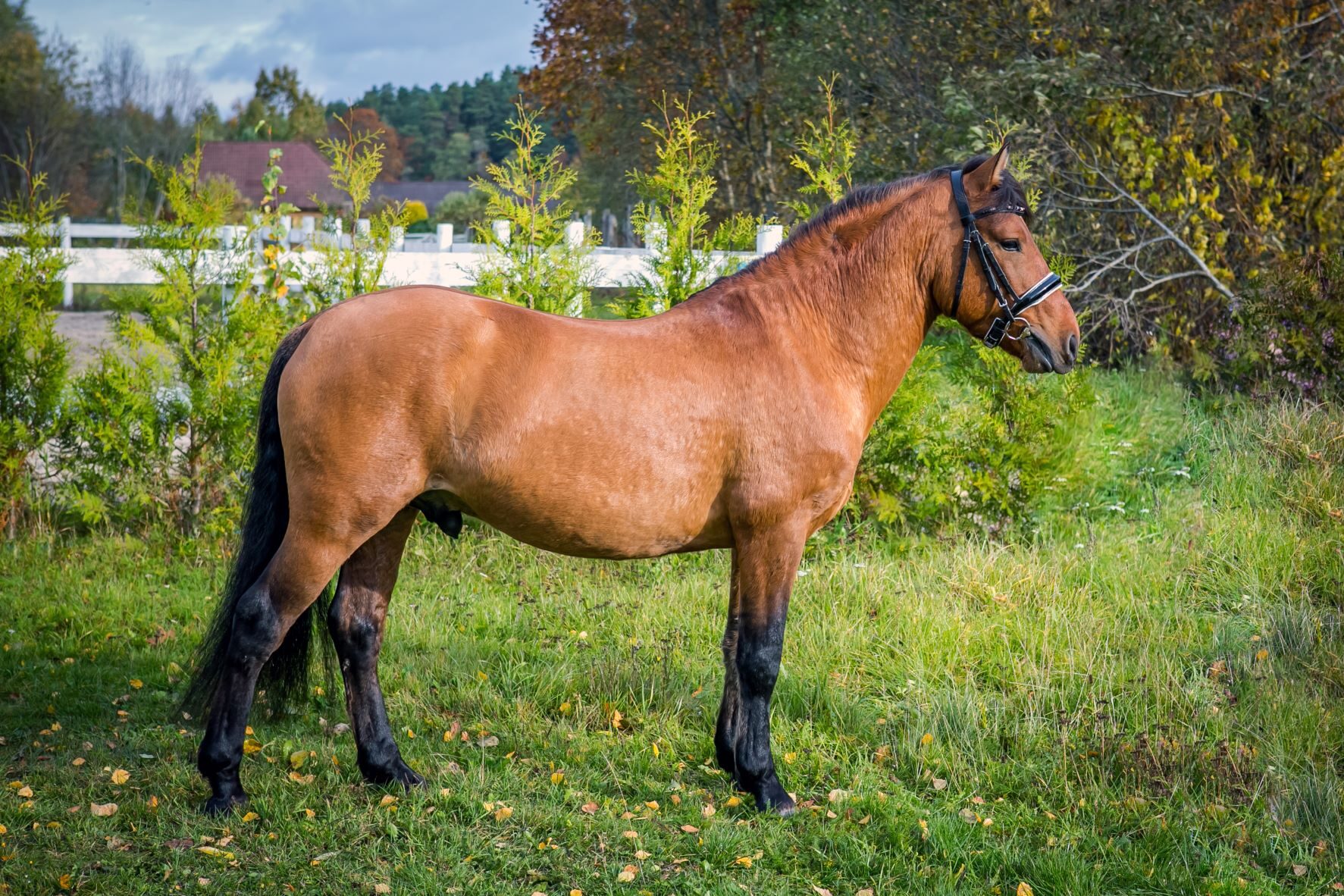
Bay stallion VELVET 938E (s. Viks 708E, d. Enia 4088E, ds. Elkar 598E, bred by OÜ Lal Merii) ©Sigrid Absalon
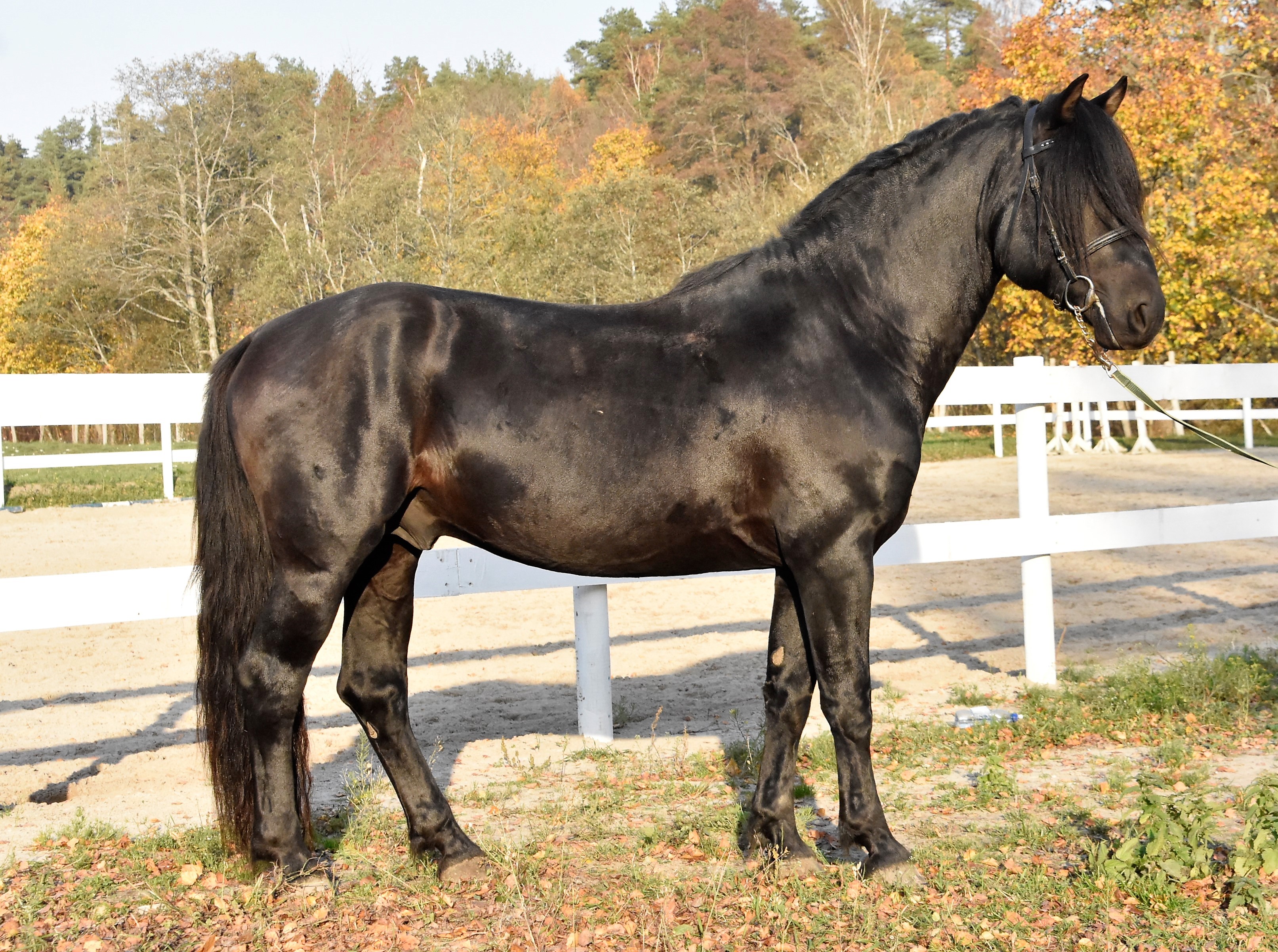
Black stallion LASER E003 (s. Laaser 833E, d. Rondo 3966E, ds. Rodeo 726E, bred by OÜ Tihuse Turismitalu) ©Riina Rõa
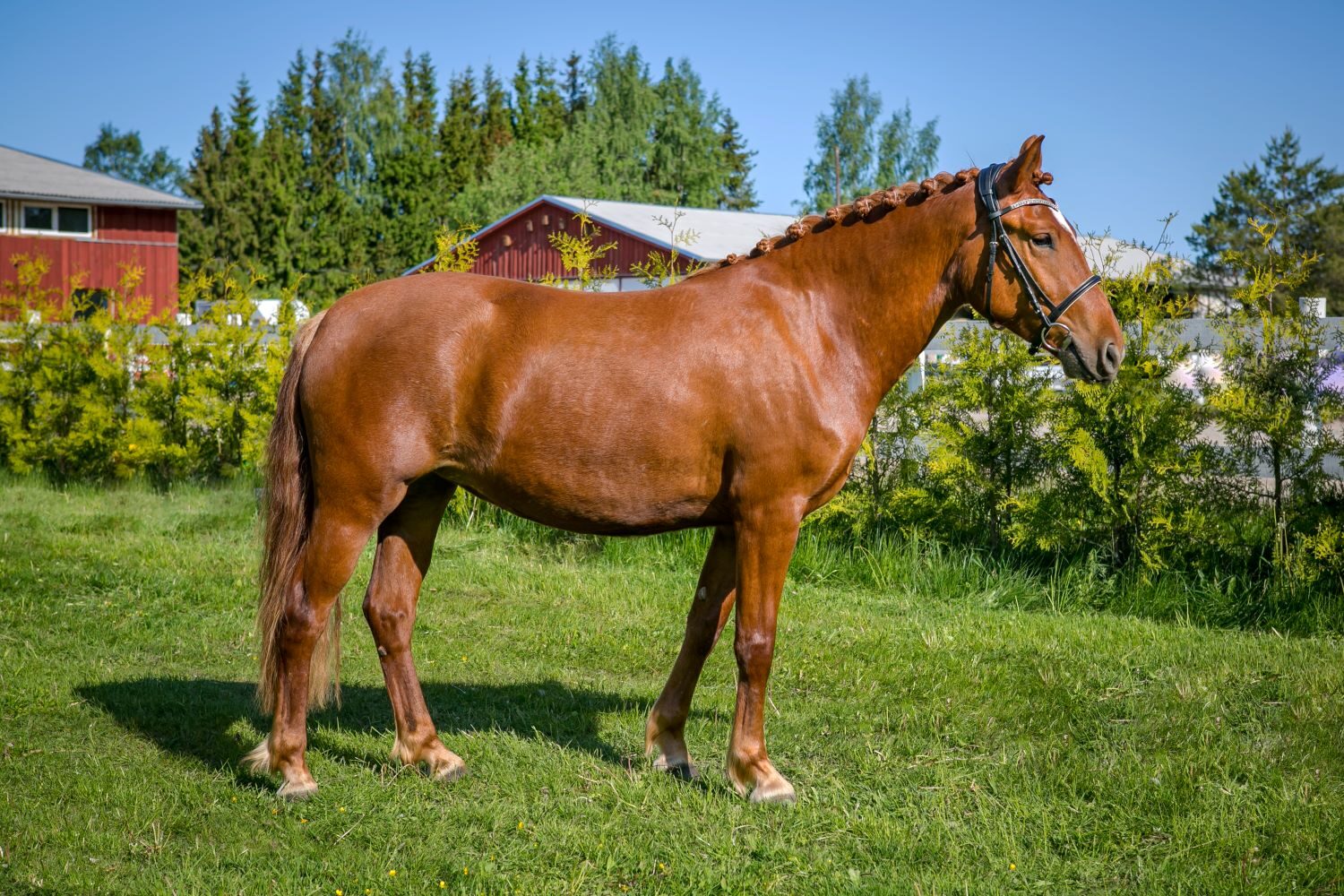
Chestnut mare ASVA LAMORE (s. Laser E003, d. Asva Aneta E1115, ds. Arthur 854E, bred by OÜ Asva Hobusekasvatus) ©Sigrid Absalon
The colour of chestnut horses can range from light reddish to nearly black steel chestnut. The exact mechanism behind the variation in shade and tone is not yet known.
Gift From The Wild – Mouse Dun
The mouse dun colour – also known as grullo, grulla or blue dun – is a smoky, blue-gray to mouse-brown colour and varies from light to dark. The underlying coat colour is black that is modified by the wildtype dun gene. The wildtype dun gene acts differently to other genes that determine horse coat colours. In 2016, scientists from the Uppsala University in Sweden discovered that this gene is responsible for the uneven distribution of the coat pigment, resulting in lighter and darker markings across the horses body. The resulting markings are dorsal stripe along the spine, a darker facial mask also known as “cob-webbing”, a transverse stripe on the shoulders and zebra-like striping on the legs. The mouse dun colour is common in wild and aboriginal horses like the Tarpan and also in donkeys. The colouring of a true mouse dun varies, depending on the seasons and also on the angle of the horse and the examiner. This must have been an excellent survival aid for the wild horses and most likely a reason the gene prevails to this day. The mouse-coloured horses could blend into the dark forests or the North, avoiding predators long enough to pass on the gift of the gene to their offspring. The dorsal stripes can be seen on horses which do not carry the true dun gene, but these horses will not have other markings. The true gene can also be determined by the dorsal stripe going all the way through the tail. The Estonian Native horses were part of the gene research in Uppsala University and a discovery was made that the wild-type dun gene expresses itself differently in the Estonian Native’s than in other horse breeds. Even if the wild-type gene is clearly present, there is little to no frosting – no white hairs on the mane or the tail. This means that for some yet unknown reason, the wild-type dun gene in the Estonian Native manifests differently than in the Norwegian Fjord and Przewalski horses. The earliest historical notes on the Estonian horses, but also the early entries in the official studbook (since 1921) show that the mouse dun colouring has been common and even regular in the breed. It hasn’t been as easy to separate dun gene carriers, because the Estonian language only has a distinct word for mouse dun (hiirjas in Estonian). The bay dun horses have often been mixed with buckskin (võik). Only by some early studbook descriptions of dark markings on ‘võik’ horses can we be certain that the bay dun has also been historically present. With the modern capacity for gene testing, it has become possible to determine the presence of the dun gene in the horses used for breeding. This allows breeders to keep statistics on how the gene works when mixed with other colours as well as select the pairings that will help us preserve the aboriginal colour that aided the ancestors of the Estonian Native to survive in the wilderness.
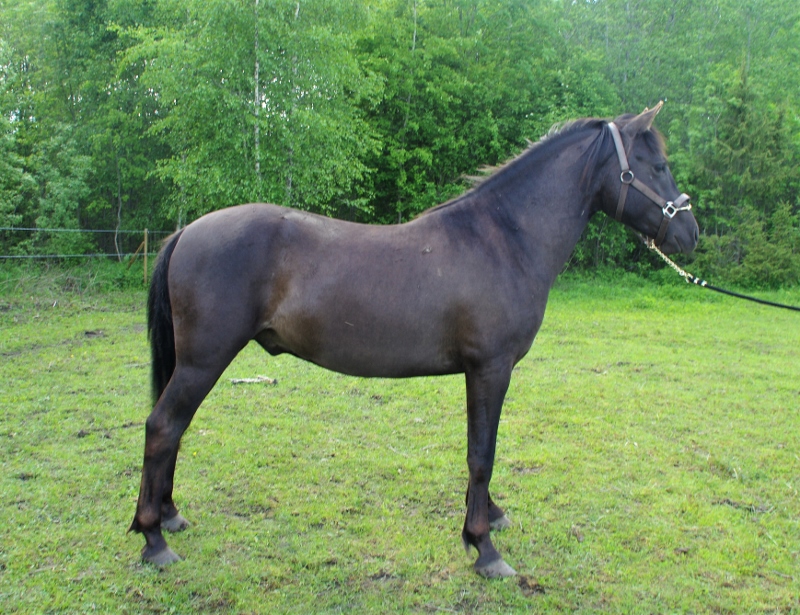
Heterozygous mouse dun stallion ELEMENT E102 (s. Epistel E028, d Vau E1083, ds. Vaks 696E, bred by OÜ Tihuse Turismitalu) ©Anneli Käo
There is a 50% chance he will pass on the mouse dun and black pigment to his offspring.

Homozygous mouse dun mare without cream-gene ELENOR E1214 (i. Ever 889E, e. Alma 4299E, ei. Apollo 778E, aret. OÜ Key) ©Anneli Käo
Her offspring will 100% be mouse dun.
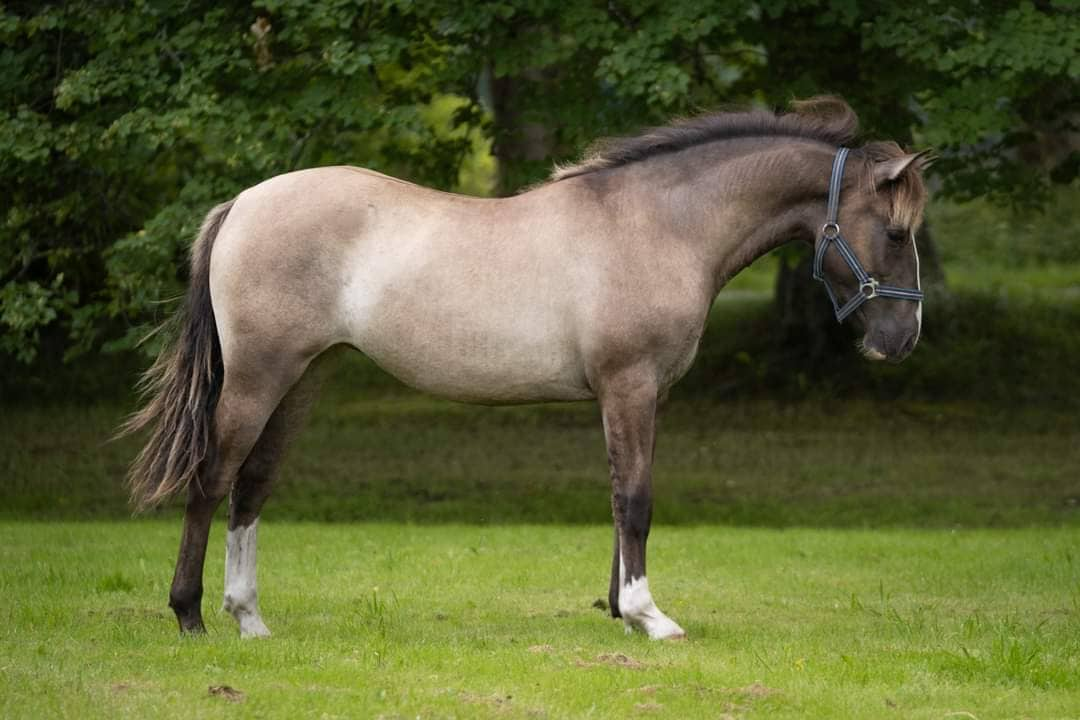
Homozygous mouse dun mare with a cream-gene VORMSI RÜÜ E1355 (s. Raju Välk E021, d. Asti 4251E, ds. Aku 684E, bred by Lea Hänni) ©Kadri Ilves
She passes the dun gene to 100% of her offspring, with a 50% chance of passing on the cream gene and black pigment.
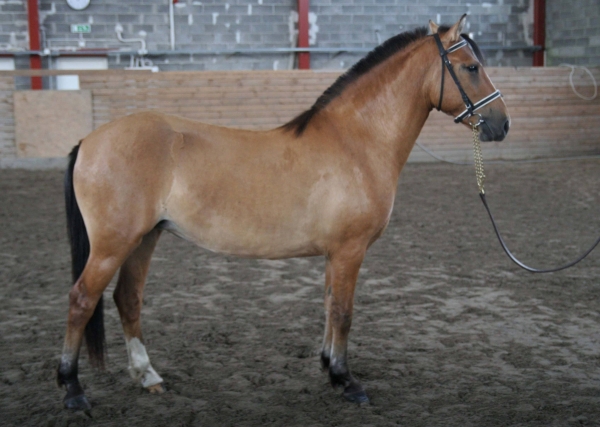
Homozygous bay dun mare VOORE AMEE 4330E (s. Apollo 778E, d. Abeelia 3606E, ds. Ando 537E, bred by Voore Tallid OÜ) ©Anneli Käo
The influence of the dun gene is clearly expressed. The body is diluted to yellowish shade, while the head and legs are darker. A prominent dorsal stripe and noticeable zebra-like striping on the legs.
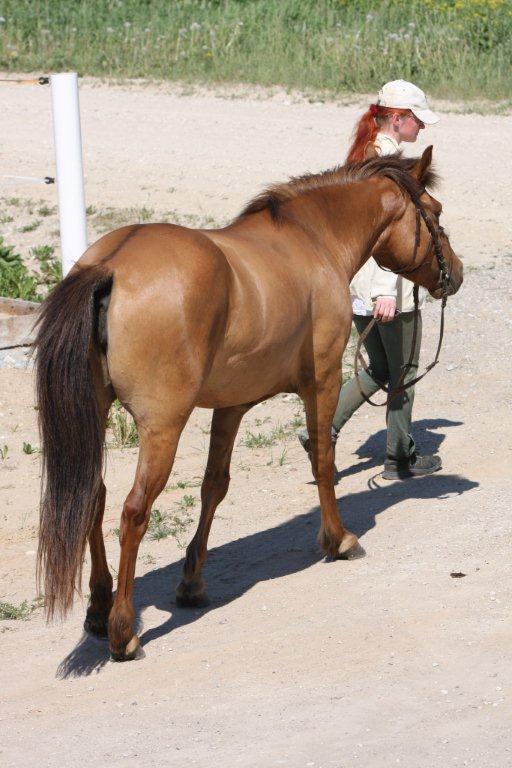
Red dun VOORE ANET 4090E (s. Aku 684E, d. Tonna 3854E, ds. Tiktor 697E, bred by Voore Tallid OÜ) ©Anu Matsoo
Easily recognized by its dun markings, her chestnut base coat is diluted to a pinkish shade on the body, while the head and legs are darker. A prominent dorsal stripe runs from the back to the tail, and the legs display clearly defined zebra-like striping.
Grey Sneaks In
None of the possible ancestors of the Estonian Native have carried the grey gene and with the available written material, we haven’t been able to pinpoint the exact insertion of the gene into the breed. In all probability, the grey – a gene that gradually turns horse coats white – came in with the horses of the crusader knights arriving in Estonia in the early 13th century. By the 19th century, the grey gene was already present in the breed and the use of Arabian stallions on Estonian Native mares cemented the gene even further.
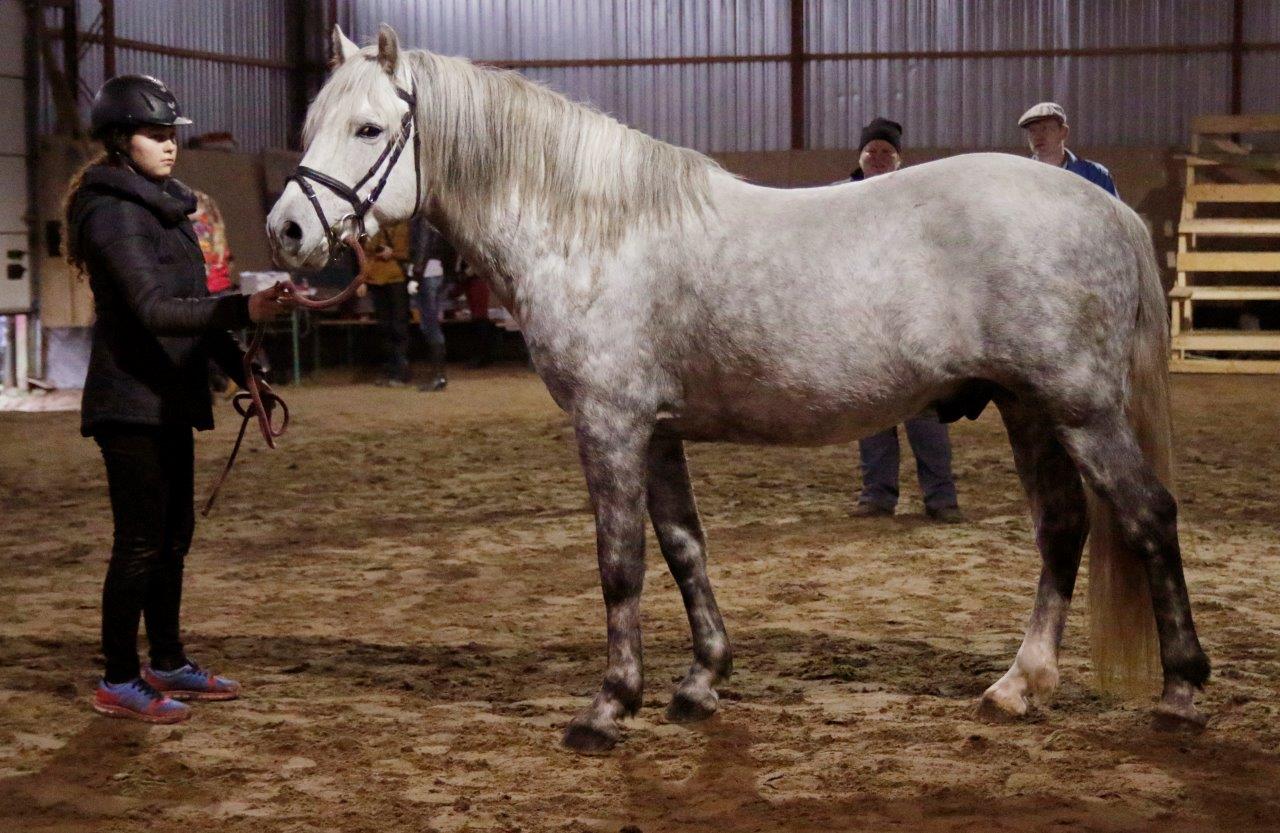
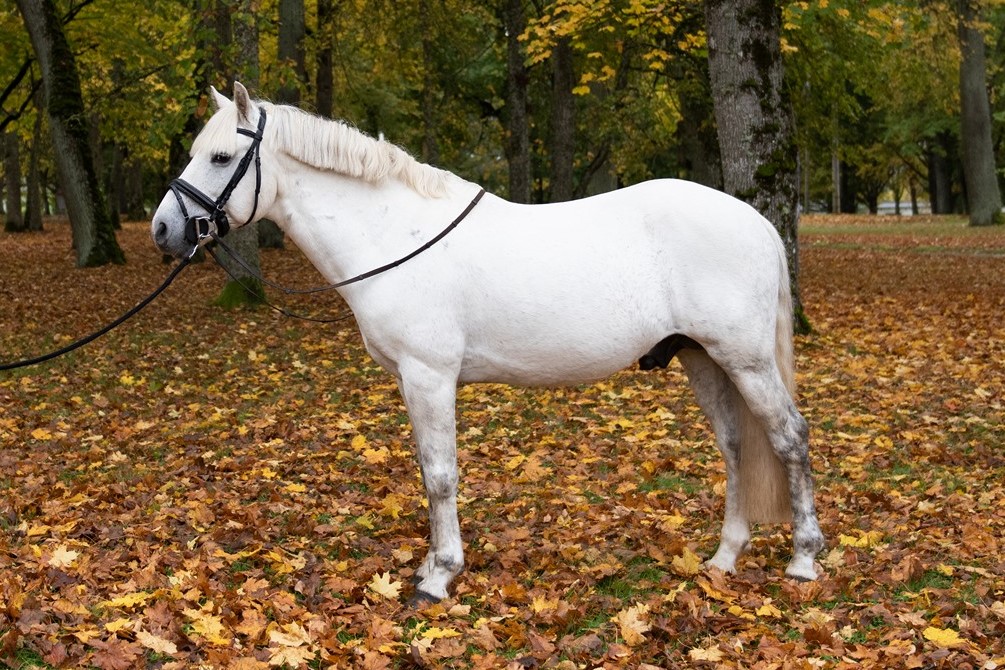
A gray stallion lost pigment from his coat and turned white ARTHUR 854E (s. Aksel 722E, d. Raasuke 4138E, ds. Rolf 716E, bred by Loore Avik). Photo 1 – 2017. ©Ago Ruus
Photo 2 – Same stallion ARTHUR 854E in the 2020. ©Gerlin Petmanson
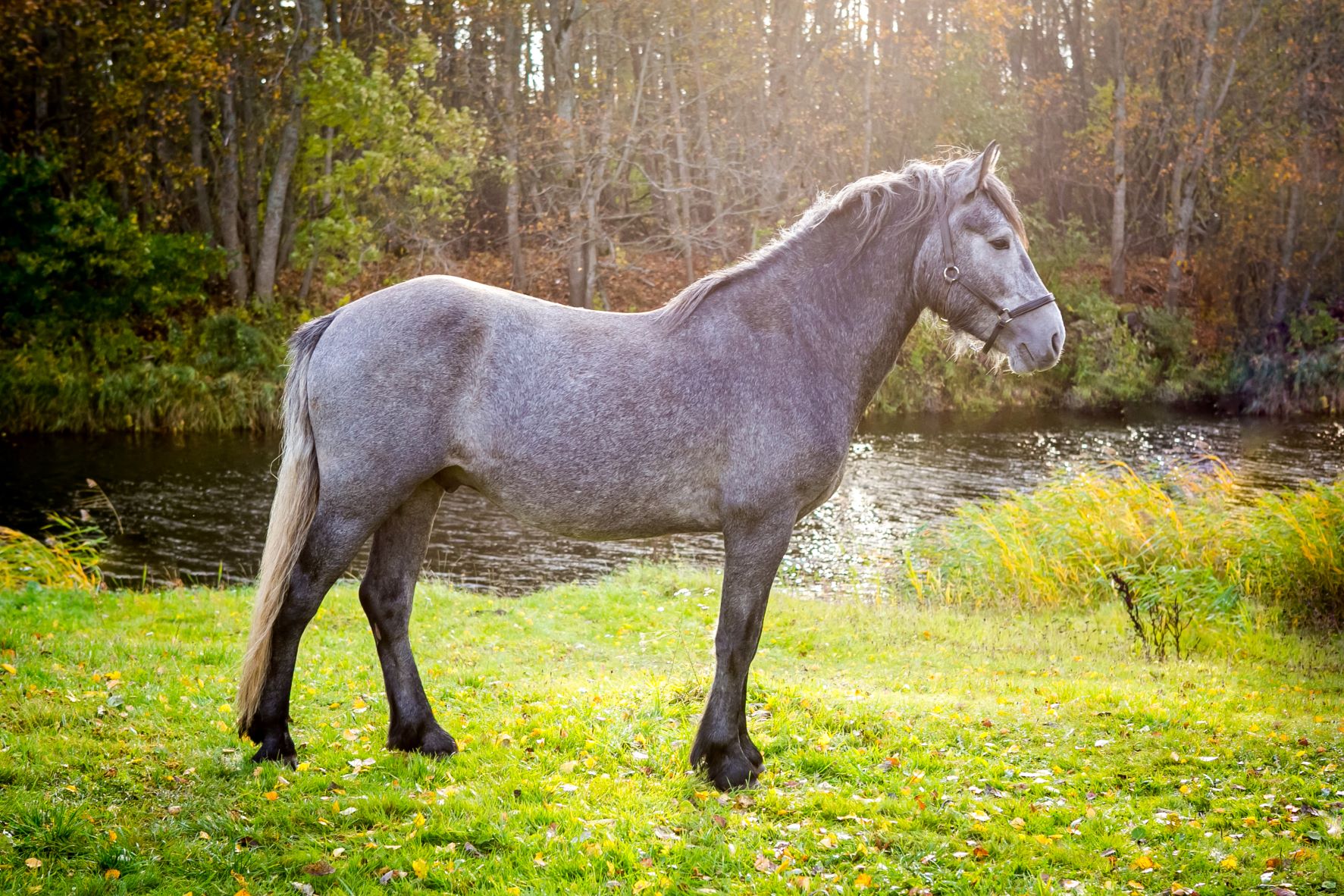
Gray stallion LARRY (s. Laaser 833E, d. Raili 4484E, ds Ramson 876E, bred by OÜ Hiiu Küülik) ©Sigrid Absalon
The gray-gene will progressively turn the horse white over time
Bringing in the Cream
In contrast to the grey, the cream gene insertion has been well-documented. Baron K. Von Hahn established the Uue-Lõve Horse Breeding Farm on the island of Saaremaa in 1870 and brought in two buckskin stallions – crosses of an Arabian horse and a Orlov trotter – to breed with the local Estonian Native mares. The cream gene was shared with more than a 1000 mares over the course of 38 years. Today, the colours produced by this gene – buckskin, cremello, palomino, perlino – have become commonplace in the breed. Two issues with this gene have been bothering the breeders. The first is that the presence of the gene can result in blue-eyed cremello offspring. The beauty of such horses is in the eyes of the beholder, yet the blue-eyed horses are more sensitive to sunlight. Another issue is a before-mentioned confusion within the Estonian language. Both bay dun and buckskin colours are described in the language as “võik”. This makes it harder for the breeders to clearly describe whether the yellow coat with black legs, mane and tail are present due to the dun gene or the cream gene.
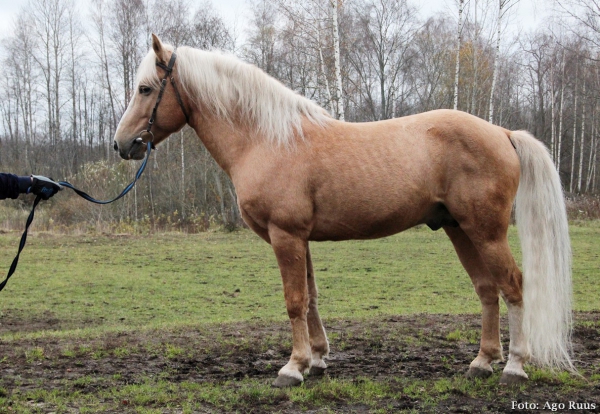
Palomino stallion TREVOR 739E (s. Trump 737E, d. Rosanna 3655E, ds. Rosett 600E, bred by Silva Siil) ©Ago Ruus
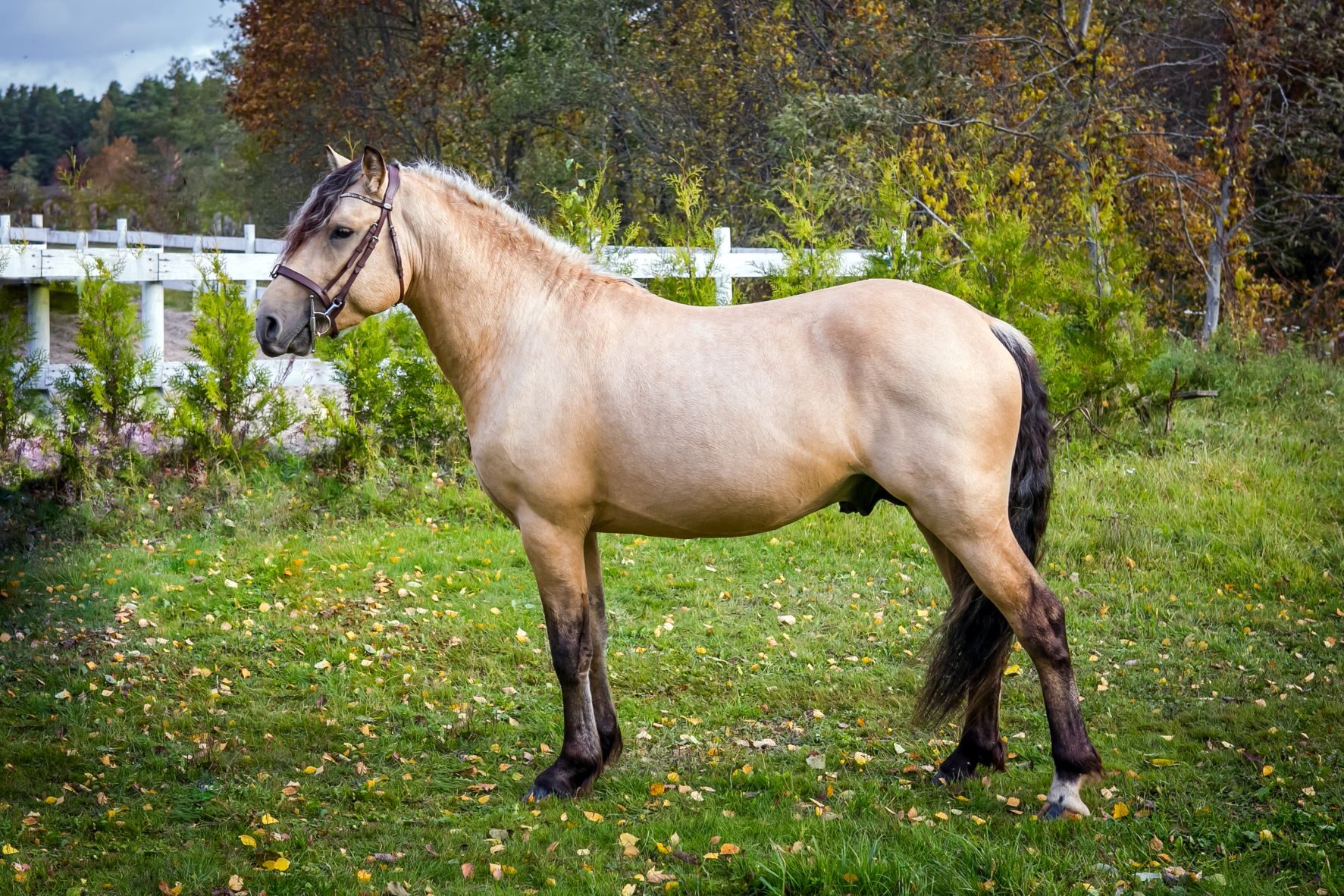
Buckskin stallion TUGRIK E050 (s. Teik 809E, d. Raha E1103, ds. Rikkur 893E, aret. Maarika Vahter) ©Sigrid Absalon
The cream-gene dilution effect on the base colour is clearly visible. Genetic testing revealed that this horse if homozygous for the agouti-gene, which prevents the birth of black offspring. All his foals with a black pigment will be born as bay.
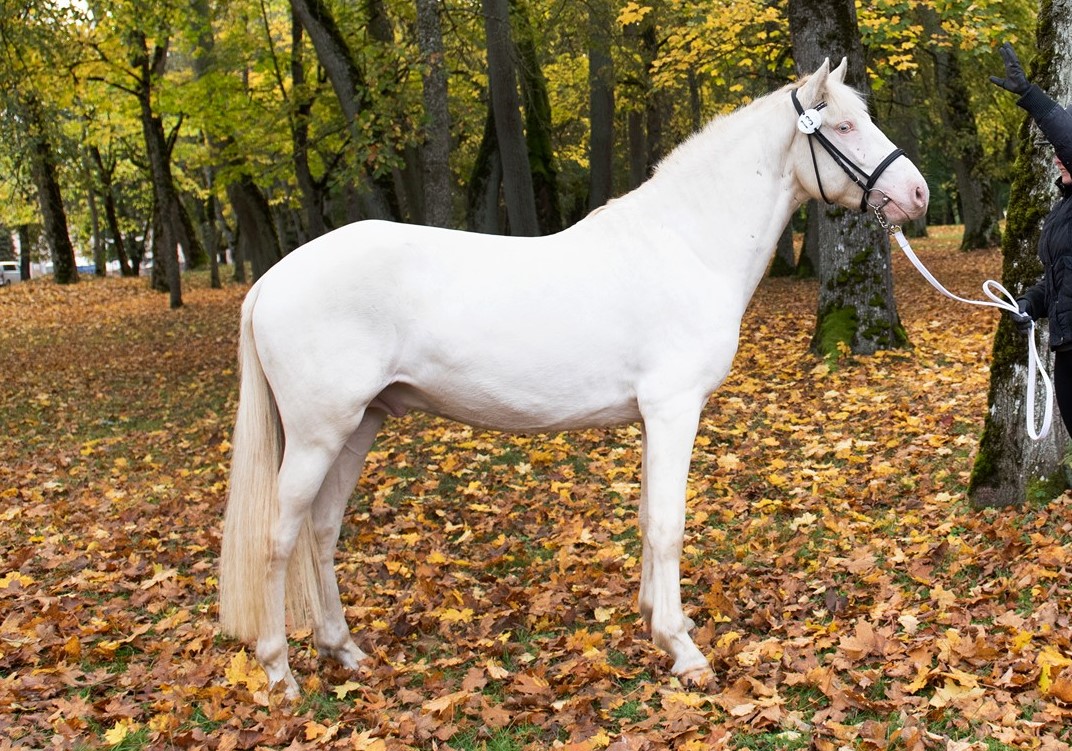
Cremello dun stallion ALGUS E043 (s. Voore Astron E001, d. Venelli 3795E, ds. Vigur 682E, aret. Margit Rändur) ©Gerlin Petmanson
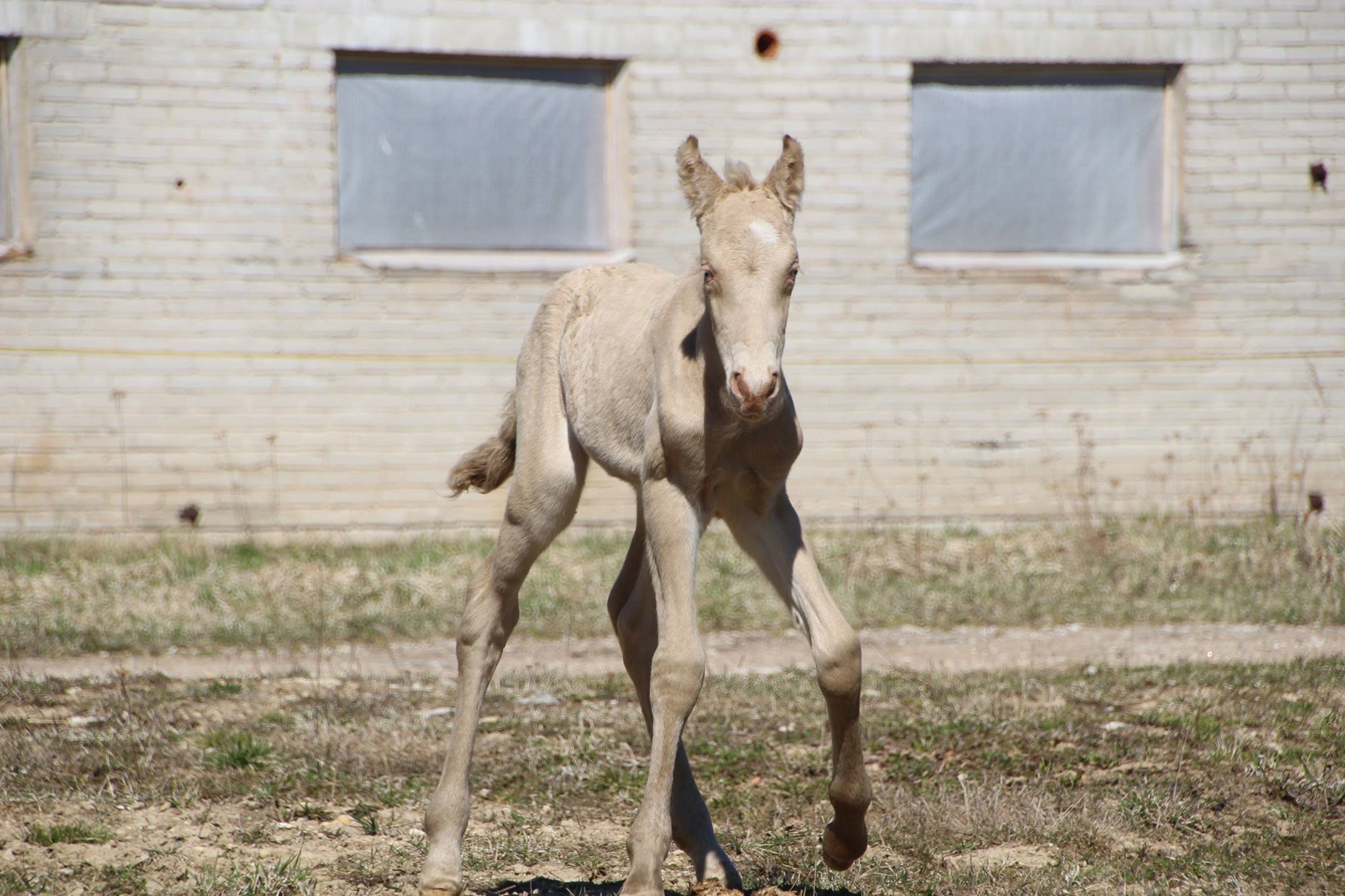
Perlino dun gelding AUGUST as a foal (s. Aksel 722E, d. Venelli 3795E, ds. Vigur 682E, aret. Margit Rändur) ©Margit Rändur
The beige coat and clearly defined markings are characteristics of Perlino dun colouring.
Roan Heads Up
Roan horses will have grey hairs distributed through the main body, with the exception of the head and the legs. There have been relatively few roan coloured horses described in the Estonian Native studbooks. Roan gene also changes the coat pigmentation with the seasons. During winter, a roan might seem to have a uniform colour while the summer coat will display clear difference between the head and the body. While the colour is somewhat rare in the breed, all types of roans have been noted in the breed – blue, bay and strawberry roans. There have been notes of other grey-mixed colour schemes, which are not caused by roan gene. The insertion of the gene has not been documented, but evidence suggests that it’s not a recent addition. It’s possible that the first roans appeared after the crusades of the 13th century. Additional roans may have been added with the use of the Ardennais stallions on Estonian Native mares.
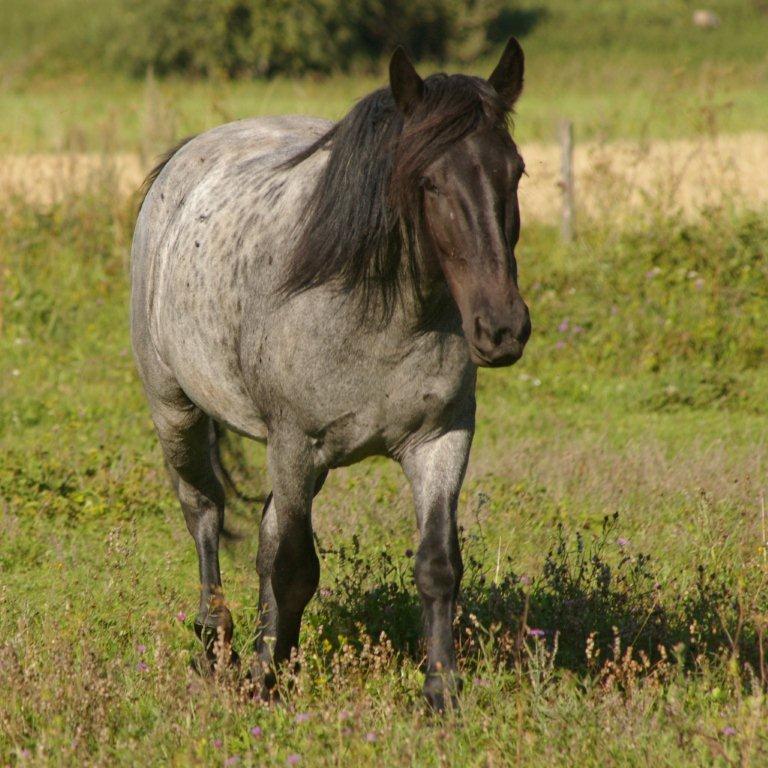
Blue roan RÖÖVEL (s. Rokkar 713E, d. Tiina 3457E, ds. Tuki 654E, bred by Ristitee talu)
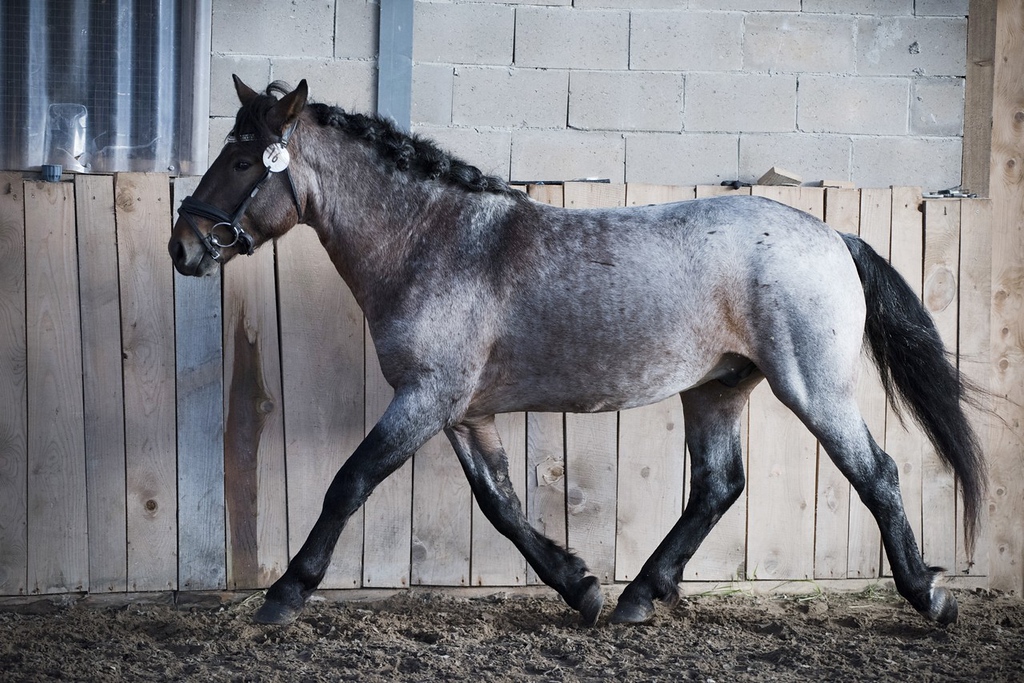
Bay roan stallion VÄITS E063 (s. Viks 708E, d. Valentiina 4110E, ds, Vigur 682E, bred by Ristitee talu) ©Kristhel Vaht
He is homozygous to the black-gene, which means his offspring will not be chestnut, red roan or any of the cream-gene colours.
Roan is one of the rarest coat colours among Estonian horses. All horses with this coloration descend from the mare Tiina 3457E. Today, these horses can be found in herds on Hiiumaa. With broader use of the stallion VÄITS E063, the spread of this colour is expected to increase.
Fashionable Silver
The silver or silver dapper gene is one of the more recent discoveries in the equine coat colour genetics. It only works on diluting the black base colour and very strongly on the tail and the mane. Chestnut horses may be hidden carriers of the gene. The most likely insertion of the silver into the Estonian Native is through the Finnish stallions imported in the mid-20th century. The silver gene is widespread in the Finnhorse breed, but since most horses are chestnut, it does not show up as often. At the same time, bay silvers are considered common. The stallions Taru 149E and Vuhti 136E were most likely bay silver horses as they have been described as chestnut horses with whiteish manes and tails. Bloodlines of both of these stallions are actively used in breeding the Estonian Native horses today. It’s important to note that silver gene carries a health risk – multiple congenital ocular anomaly – that may result in eye disorders leading to reduced vision or blindness for the horse. It’s not advisable to breed two horses carrying this gene.

Silver black stallion ROKKAR 713E (i. Romm 611E, e. Tulli 3388E, ei. Tuljak 417E, aret. Sonja-Hilli Torn). ©Ago Ruus
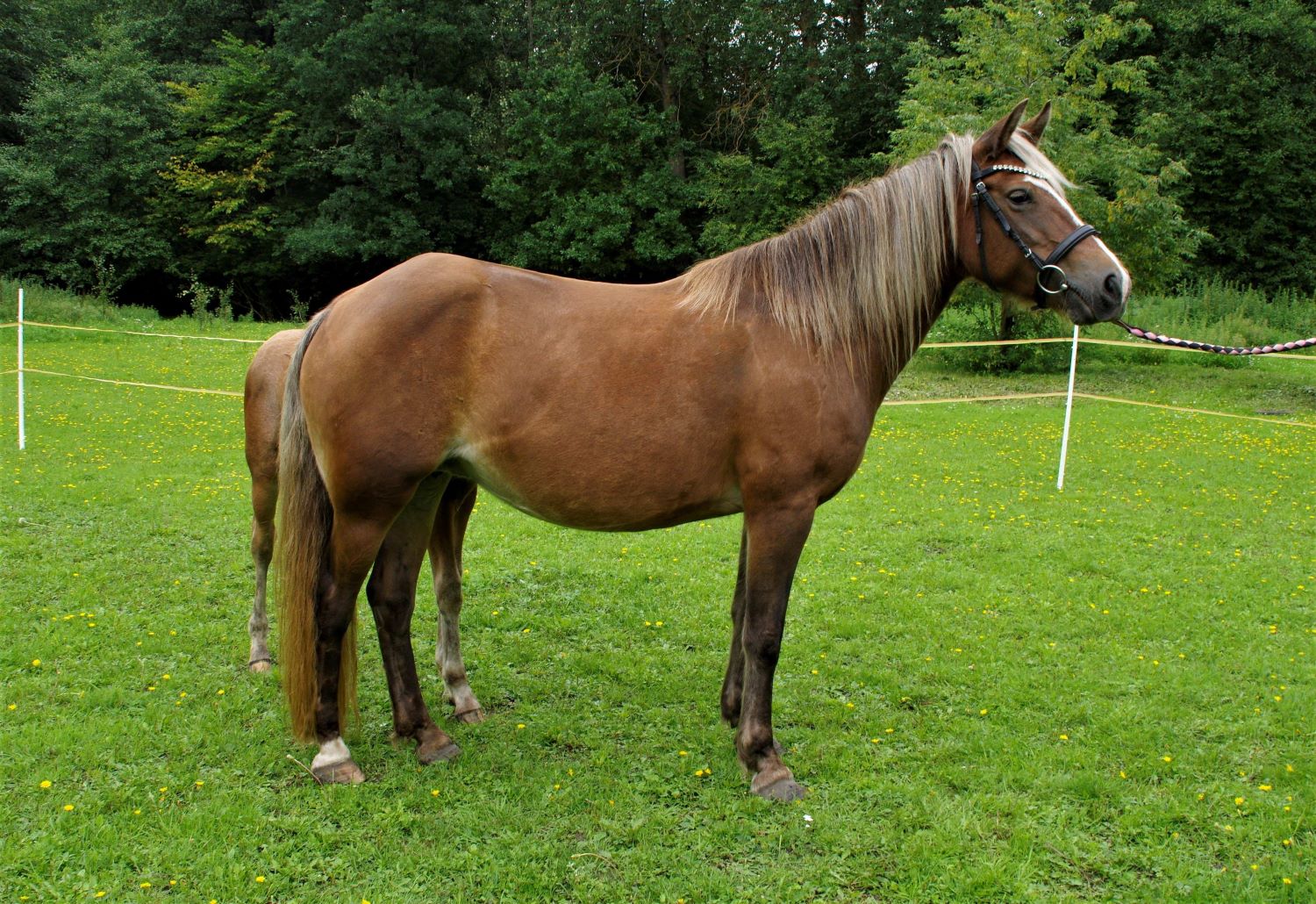
Silver bay mare MUUKSI RALLA E1144 (s. Rob Roy 768E, d. Vigri 4292E, ds. Vihur 733E, bred by OÜ Muuksi Muhe) ©Anneli Käo
Good example of silver-gene diluting the black pigment from the base bay colour.

Silver buckskin stallion ROKK E051 (s. Raks E011, d. Vau 1083, ds. Vaks 696E, bred by Tihuse Hobuturismi talu) ©Anneli Käo
Heterozygous to black and cream genes. No colouring can be ruled out for his offspring.
Regulated White Markings
Regardless of when the various colour dilution genes entered the breed, they are welcome and allowed as a testament to the colourful history of the Estonian Native. Such is not the case with white markings. It is believed that the aboriginal Estonian Native carried no white markings on their bodies. Naturally, with the centuries of meticulous and less careful cross-breeding, many Estonian Native horses carry some facial and leg markings. Those markings are permitted as long as the type and feel of the horse display the characteristics of the original Estonian Native. When selecting horses for breeding, smaller markings are preferred and body spots are not advised. The reason for this restriction is simple – the breeders wish to respect and gradually restore the look and feel of the aboriginal Estonian Native. That objective has been encouraged by the fact that wild genes have remained dominant in the breed and regardless of the many influences and crosses, the type and character of the Estonian Native horses are considered remarkably similar to the horses described in historical documents. The modern Estonian Native horse – brought back from the brink of extinction – can be as colourful as is the history of the breed. All the added colours and the careful selection of white markings can also be considered a bonus and a blessing. Today, every horse person can choose their own flavour of the Estonian Native – a wild-type mouse dun with no markings or a black silver with glorious stockings. Both are beautiful and wonderful in their own way.
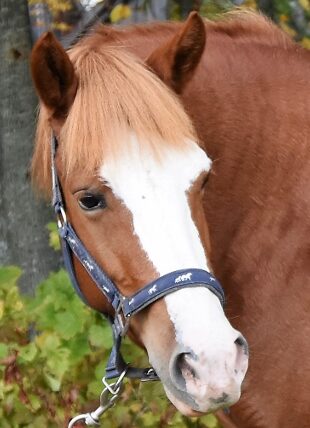
Chestnut mare RANGERJE (s. Roobert 905E, d. Riile E1068, ds. Rellu 870E, brea by Ristitee talu) ©Anu Matsoo
Broad white blaze.
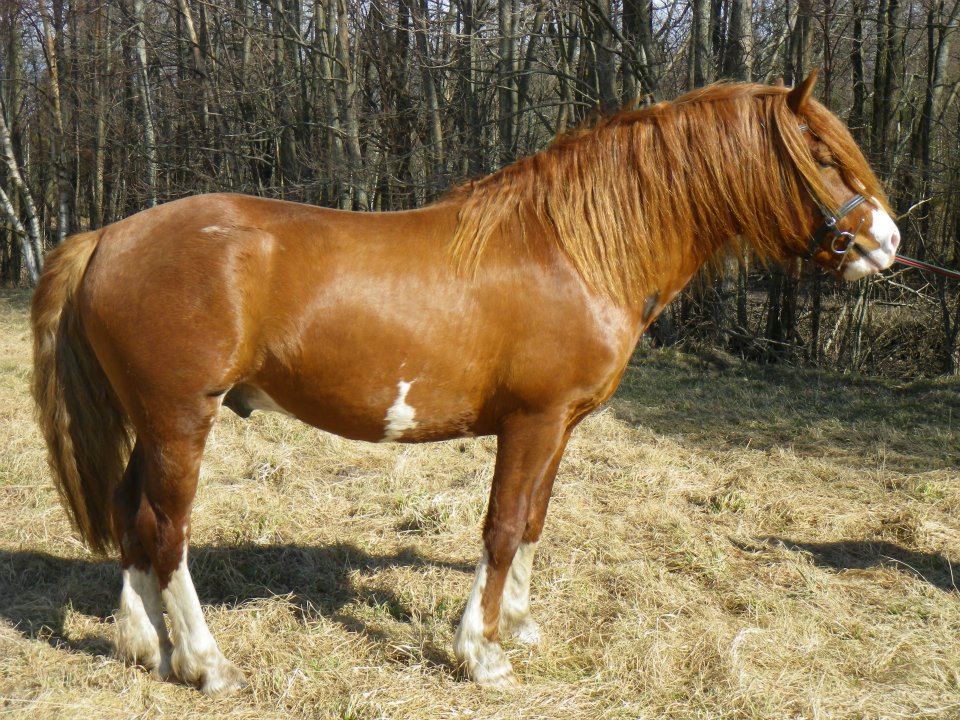
Chestnut gelding AHARON 855E (s. Ahtos 755E, d. Lolita 4095E, ds. Laasik 711E, bred by Siret Põllu) ©Siret Põllu
White makings on face, body and feet are deemed undesirable for breeding. Therefore, the stallion was gelded.
Combining dilution genes
Previously, the effects of various dilution genes and modifiers on base coat colors have been described separately. However, a horse’s coat colour can be determined by several genes acting simultaneously. These situations make it particularly difficult to predict the colour of foals. A single horse’s base colour can be modified by the cream gene, silver gene, and dun gene, and in addition, the roan gene. Gray can mask all colors. It may not be long before we encounter mouse dun roans or silver black roans. For this reason, it is increasingly important for breeders to have a solid understanding of horse coat colour genetics and to consult the pedigree when determining a foal’s likely colour. If phenotypic (visual) determination is not possible, examining the pedigree can either rule out certain possibilities or provide clues about likely outcomes. Since it is not always possible to accurately determine a foal’s colour without testing, the horse’s actual colour can later be added to the studbook. The basis for colour determination is the phenotype, but breeders are increasingly interested in the genotype, i.e., the horse’s true genetic colour. Genotype can sometimes be inferred partially or fully from the pedigree or offspring, but testing provides the most accurate result. This information is particularly valuable for understanding which colours a horse may pass on to its offspring. The currently available coat colour registry for Estonian Native horses allows breeders to assign a colour designation that accurately reflects the horse’s genotype.
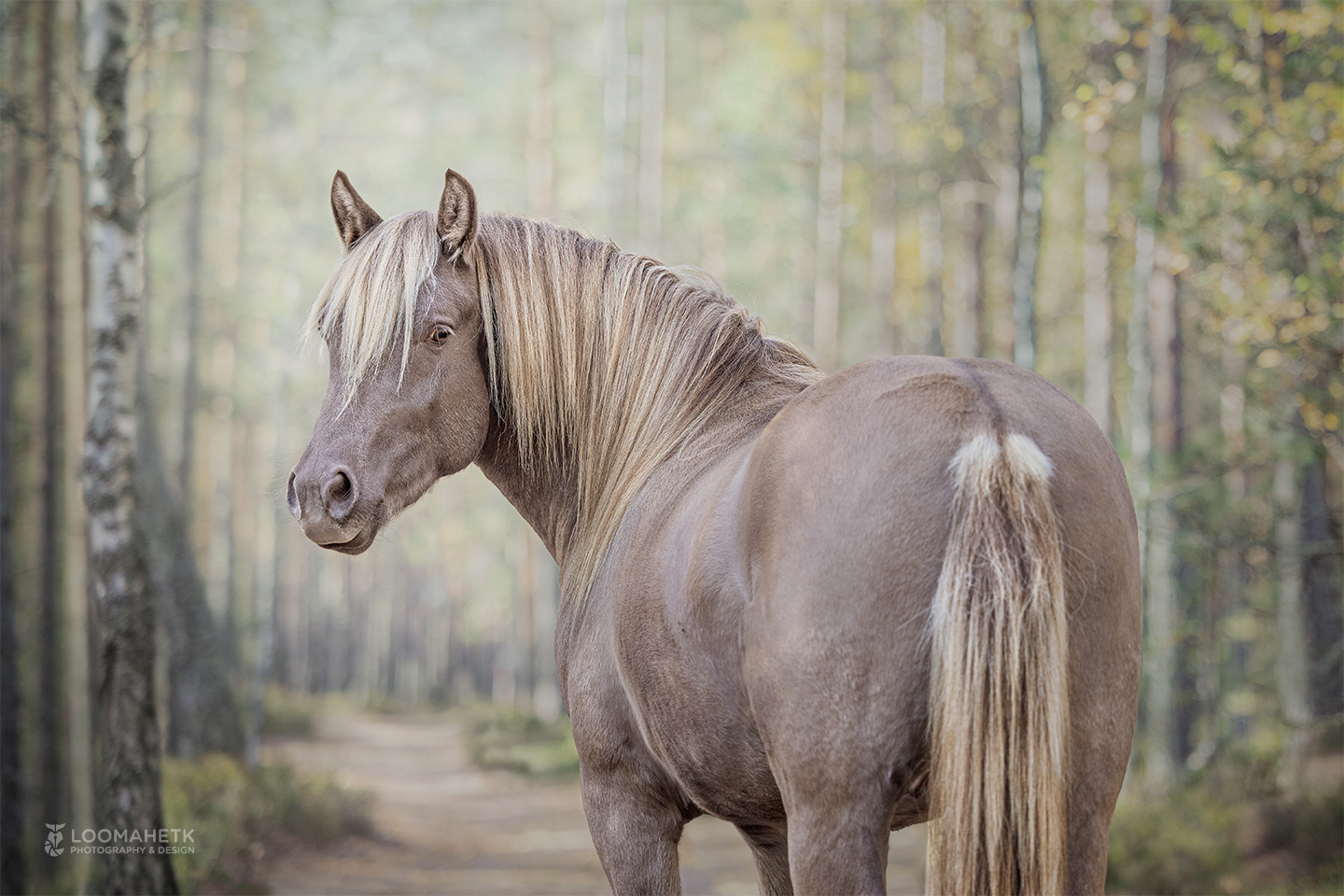
Silver-cream mouse dun stallion VOORE ANTARIS E055 (s. Apollo 778E, d. Reia 4345E, ds. Rotser 742E, bred by Voore Tallid OÜ) ©Loomahetk
A homozygous black horse simultaneously modified by three dilution genes: dun, cream and silver. This combination has changed his iris into light amber, the mane and tail to silver. The dun gene is evident in the dorsal stripe, zebra-markings on his legs and light inner ears. This stallion also changes colour with the seasons.
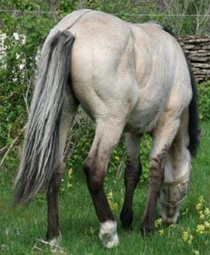
Buckskin dun mare AURA (s. Apollo 778E, d. Elviira 4134E, ds. Eskort 705E, bred by Aivo Välja)
Clearly visible zebra-markings on the legs. The cream-gene has diluted the otherwise bay dun mare’s coat into light-pink.

Mouse dun stallion with the cream-gene VOORE ASTRON E001 (s. Apollo 778E, d. Abeelia 3606E, ds. Ando 537E, bred by. Voore Tallid OÜ) ©K-K. Nigesen
The smokey gray colouring, the dorsal stripe and visible zebra-like markings on the legs are common in dun horses. Cream-gene is responsible for the bleached look.
WHY CHOOSE AN ESTONIAN NATIVE?
There are many reasons to love this versatile breed. The Estonian Native horse is ideal for riding schools, on tourist rides; as a children’s pony or a family favourite.
● They have a charmingly active and cheerful character, while also being calm and pragmatic. With an easy, yet energetic temperament, the breed is very pleasant in contrast to pretentious warmbloods and the indifference of large draft horses.
● The horses are remarkably low-maintenance. The breed is well-adjusted to thrive on pastures by forage alone, except during winter times when hay and shelter would be needed.
● They have good fodder utilisation and do not require special feeds.
● Their size and versatility of use. Estonian Native range from mid-size ponies to small horses which can be ridden by both children and adults.
● Most Estonian Native horses have strong legs and incredible pulling strength for their size. They can perform well in many disciplines from carriage driving to eventing.
● Robustness and longevity. Usual life span is between 20-30 years.
The Estonian Native horse breed has been listed as one of the world’s endangered species by the Estonian Government and the Food and Agriculture Organization of the UN. As of May 2024, there are ~2700 Estonian Native horses in the world, most of them in Estonia.
More about this rare breed in Wikipedia
See our horses for sale in Estonia: HERE
CONTACT US
ESTONIAN NATIVE HORSE BREEDERS SOCIETY
Registration code: 80374660
VAT nr: EE102588378
Legal address: Tihuse, Hellamaa küla, Muhu vald, Saare maakond, 94741
e-mail: eestihobuseselts@gmail.com
telephone: + 372 55 14 558